
MIWI RESORT
CENCEPT ARCHITECT
MIWI RESORT AT MIWI ISLAND – ZANZIBAR


Miwi Resort is envisioned as a distinctive island retreat, carefully designed to celebrate the rare and pristine character of Miwi Island, located within the coral forest of Kwani Bay, Zanzibar, off the eastern coast of Tanzania in the Indian Ocean.
Miwi is a unique coral island with no natural soil, yet it is densely covered by tropical vegetation and mature trees, including iconic Baobabs. These plants thrive atop the coral surface through centuries of accumulated organic debris that has gradually decomposed into nutrient-rich humus. The island remains uninhabited, free from land-dwelling animals, and untouched by modern development. Birdlife occasionally inhabits the island during resting periods, while constant ocean breezes moderate the tropical climate. With exceptionally clean air, expansive blue skies, and complete absence of vehicular noise, Miwi Island offers an environment of pure tranquility, entirely free from air and noise pollution—an ideal setting for a world-class destination resort.
Rooted in this exceptional natural and cultural context, Miwi Resort is designed to embrace and enhance the island’s inherent qualities. The architectural language adopts a modern vernacular approach, inspired by the coastal tropical forests of coral islands and enriched by Zanzibar’s architectural heritage. The design draws from traditional Swahili elements—such as carved doors, windows, balconies, balustrades, roof finials, and ornamental details—many of which have been recognized by UNESCO as part of the world’s cultural heritage. These elements are reinterpreted with contemporary proportions and detailing to create architecture that is both timeless and forward-looking.
Construction materials are carefully selected to respect both environmental conditions and logistical realities. Primary materials include wood, natural stone inspired by Stone Town, bamboo, glass, and African thatch (rumbia or alang-alang). The use of reinforced concrete is intentionally minimized due to transportation challenges and environmental sensitivity, while steel structures are discouraged because of corrosion risks in the marine environment. Reinforced concrete will be selectively employed only where technically essential, such as for piling systems supporting water villas and boardwalk pilotis.
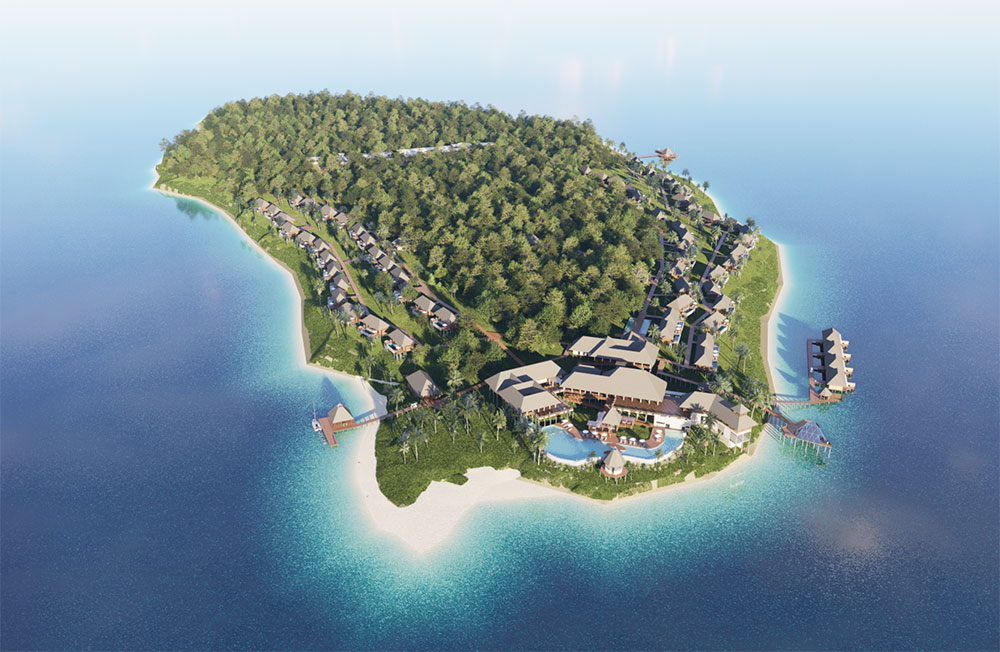
The masterplan responds organically to the island’s natural topography and vegetation density, with development concentrated toward the northern portion of the island—the only open area offering expansive white sandy beaches. Building placement follows the island’s gradual elevation, beginning from low coral cliffs with sparse vegetation and rising gently toward the denser forest at the island’s center. This approach minimizes tree removal while ensuring unobstructed views and a seamless integration between architecture and landscape.
Key planning principles include:
- Villa clusters positioned along the cliff edge and gently elevated toward the forest for privacy and views.
- Back-of-House (BOH) facilities centrally located to efficiently support current operations and a planned second-phase development on the southern portion of the island.
- Main resort amenities situated at the northernmost tip, directly connected to the beach and arrival experience.
- A temporary jetty (subject to bathymetric studies) proposed on the western side of the island, where deeper waters appear accessible.
Interior design continues the philosophy of natural refinement, emphasizing organic materials, warm tones, and tactile textures. Local Swahili motifs and decorative traditions are interpreted in a contemporary manner, creating spaces that feel authentic yet internationally sophisticated. Guest areas—particularly villas and fine-dining venues—are defined by understated luxury, supported by premium selections of sanitary ware, tableware, and cutlery to elevate the overall hospitality experience.
Landscape intervention is intentionally restrained. Only areas immediately surrounding buildings and outdoor facilities will be landscaped, while the vast majority of the island will remain preserved as pristine natural forest, potentially thousands of years old. Planting strategies prioritize native species, complemented by select flowering plants to introduce color and enhance arrival and gathering areas without compromising the island’s ecological integrity.
Through this carefully balanced approach, Miwi Resort aspires to become a rare and meaningful island destination—one that honors nature, culture, and craftsmanship while delivering an exclusive, serene, and deeply immersive hospitality experience.